AWAY FROM THE DIVISION OF THE TOWNS
The Municipalities Must Remain United and Indivisible
A series of four articles by the Mayor of Famagusta, Andreas Pougiourou,
written exclusively for “Eleftheria”, 25–29 June 1961.
In the summer of 1961 the separation of the municipalities of the five main towns — a provision of the Zurich–London Agreements and of Article 173 of the Constitution — was the most critical open question facing the newly established Republic of Cyprus. The Mayor of Famagusta, Andreas Pougiourou, who had been elected with the support of AKEL, published the following series of four articles in “Eleftheria” a few weeks before the extension of the Municipalities Law expired on 16 July 1961. He argued that separating the municipalities along ethnic lines would lead to the territorial partition of the island.
Ελληνικό πρωτότυπο · Απόδοση στη δημοτική
CONTENTS
Part A — 25 June 1961 (Pages 1 and 5)
Part B — 27 June 1961 (Pages 1 and 5)
Part C — 28 June 1961 (Pages 5 and 6)
Part D (last) — 29 June 1961 (Page 2)
Part A
“Eleftheria”, 25 June 1961 — Pages 1 and 5
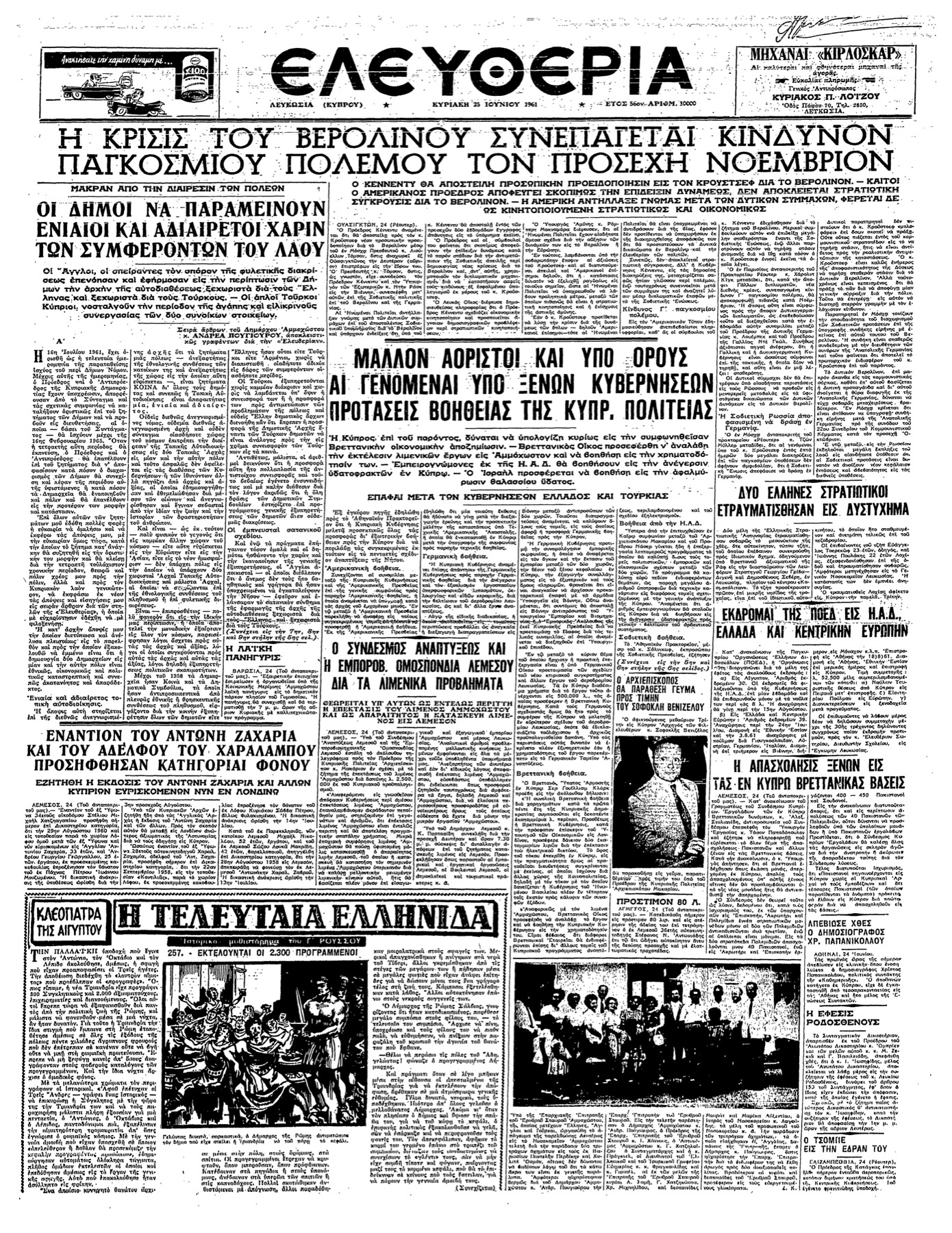
The English, having sown the seed of racial discrimination, devised and applied to the case of the Municipalities the principle of self-determination separately for the Greeks and separately for the Turks. — The ordinary Turkish Cypriots long for the period of love and sincere cooperation between the two cohabiting elements.
16 July 1961 has been fixed as the final date of the extended validity of the Municipalities Law. Until that date, the President and the Vice-President of the Republic of Cyprus have an obligation, deriving from the Constitution and the relevant agreements, to reach a definitive settlement on the question of the Municipalities and to make arrangements which — on the basis of the Constitution — will remain in force until 16 February 1965. When this four-year period expires, the President and the Vice-President will return to the question in order to decide whether the separation of the Municipalities will continue to exist even beyond that period, or whether the Municipalities will once again be unified and return to their former form and condition.
On all these matters I have been given many opportunities to speak and to express my views. Taking advantage of the present occasion, however, when the issue must necessarily be discussed in its definitive form and closed for at least a four-year period, I consider it once again my duty both to the city and, more generally, to the Cypriot people to express my views and suggestions anew in a series of articles through the columns of Eleftheria, which has kindly agreed to host me.
My fundamental view, which I have repeatedly formulated and analysed in the past and to which I continue to adhere, is that the creation of two Municipalities in one and the same city is nationally, economically and politically disastrous and therefore incomprehensible and unacceptable.
Unified and indivisible local self-government.
This view is based on the internationally recognised principle that the affairs of a city — regardless of the ethnic composition of its inhabitants and regardless of the country in which it is located — are common matters for all its citizens, and therefore Local Self-Government must necessarily be one, unified and indivisible.
No internationally recognised law, no internationally recognised principle, and no constitution of any country in the world permits the division of Local Self-Government into two Local Authorities in one and the same city. This is certainly not due to the dispositions of governments or of those in power, but stems from principles and values which were created and established through the centuries and which have been recognised and respected by life itself and by the history of human activity.
It is therefore entirely natural that in no other country in the world — whether in Europe or Asia, or in the New World — is there a city in which there exist two separate Authorities of Local Self-Government, and moreover Authorities based on the ethnic composition of the population or on racial division.
It is, moreover, very clear that in our own case, which constitutes the sole exception in the entire world, reasons extraneous to these principles and values have intervened — reasons which conflict with these principles and values, that is to say, reasons serving political expediencies.
Until 1958 the Municipalities were common, and the Municipal Councils, which were representative from the standpoint of the ethnic or religious composition of the population, worked for the common service of all the citizens, whether they were Greeks, Turks or Armenians, without any injustice being observed against the interests of any section.
The Turks were served without any discrimination and without regard to their contribution or offering towards meeting the problems of the city, and no Greek municipal authority ever even conceived that the offering of the Municipal Authority to the Turkish citizens should be proportional to the monetary contribution of the Turks to the common funds.
On the contrary, the figures show that this offering was many times greater than the corresponding contribution, and this was of course done deliberately and with goodwill precisely because the entire activity of the Municipal Councils was based on a programme of general service to the citizens without any discrimination.
The inspirers of a satanic plan.
And while things were proceeding so smoothly and the citizens felt the joy and satisfaction of general service, the English colonialists — who foresaw that the wind was not favourable to them and that they would soon be obliged to leave the Island — invented and launched the satanic slogan of applying the principle of self-determination separately for the Greeks and separately for the Turks.
(Continuation in the 7th, 8th and 9th columns of page 5.)
(Continuation from page 1.)
However, this slogan of theirs (which, it may be said in passing, they did not have the courage to put forward even before the United Nations, where the Cyprus question was being discussed) could not practically find application. For this reason they devised and applied this “principle” in the case of the Municipalities. Timidly the English Governors were saying at the time that the creation of separate Turkish Municipalities constituted a practical application of the right of self-determination in miniature!!!
And certainly — while they did not dare openly to proclaim this thing — it is certain that the idea of the separation of the Municipalities basically starts from and essentially aims at serving the purpose of the future partition of Cyprus into two.
It was precisely here that the English sowed the seed of racial discrimination, and I believe that this finding must become the general finding of all of us so that the evil may be prevented before it proceeds to its completion. For, whether we wish it or not, things are being led definitively in this direction, and it will depend on all of us — both Greeks and Turks — to prevent and remedy it.
For, since we already have separate Parliaments, separate Courts, separate cooperative institutions, and an almost separate economic and social life, why should we not expect that we will reach the point where America and South Africa are today, where there are separate parks for the Blacks, separate buses for the Blacks, and separate roads and places of assembly for the Blacks?
I would particularly wish to emphasise and underline this point, because I feel that if reason does not prevail and if the spirit of mutual understanding and cooperation does not predominate, and if the paths that will lead us out of the labyrinthine situation being created are not found, neither Ariadne’s thread will help us nor will prayers prove useful and serviceable.
The issue is for both Greeks and Turks to understand that we are being led towards the precipice. We must rediscover ourselves and try to become conscious once again that our interests are common.
Personally I believe that this need is understood not only by the Greeks but also by the ordinary Turkish Cypriots. From the contact I have with them I have formed the conviction that the common people remember the good old days of love and sincere cooperation and long for the creation of the appropriate conditions so that we may return to the same state, so that the old consciousness may be revived, so that the factors of recomposition and cooperation may be created, and so that the definitive racial discrimination may thus be avoided, which with mathematical precision will lead us into the abyss of destruction.
“Divide and rule.”
From the above it is beyond any doubt clear that the creation of separate Turkish Municipalities was dictated not by reasons of serving the so-called “particular Turkish interests,” but by reasons of political expediency, reasons which basically and essentially serve the imperialists, whose doctrine is “divide and rule.”
The English imposed an agreement which secures for them many and [……] rights in Cyprus, rights which [……] at the appropriate given moment the real sovereigns. From the bases, where they are located with absolute and full sovereign rights, they wish to hold the reins, with the effort that everything that is done should serve their own policy and their own interests. And certainly the interests of our former sovereigns and present co-sovereigns are not identical with the interests of the Cypriot people.
The English have every reason to keep our people divided and, above all, to keep the Greeks and the Turks divided. And for this precise reason they tried to transplant into the consciousness of the Turks that they were wronged, that the Greek municipal authorities despised and trampled upon their interests, and that from the standpoint of self-determination they have their own, entirely particular interests. Thus they compelled the Turkish leaders about three years ago to proclaim that the injustices against the Turkish minority on the part of the Greeks were so great and so [unbearable?] that they compelled them to violate the law and to create their own Municipalities for the protection of their interests.
This of course constitutes the pretext. The cause, however, is different. The cause is to keep the people divided, and moreover divided on an “ethnological” basis, with the exclusive aim of frustrating the realisation of the goals pursued by our people, that is, the securing of its independence and freedom.
Part B
“Eleftheria”, 27 June 1961 — Pages 1 and 5
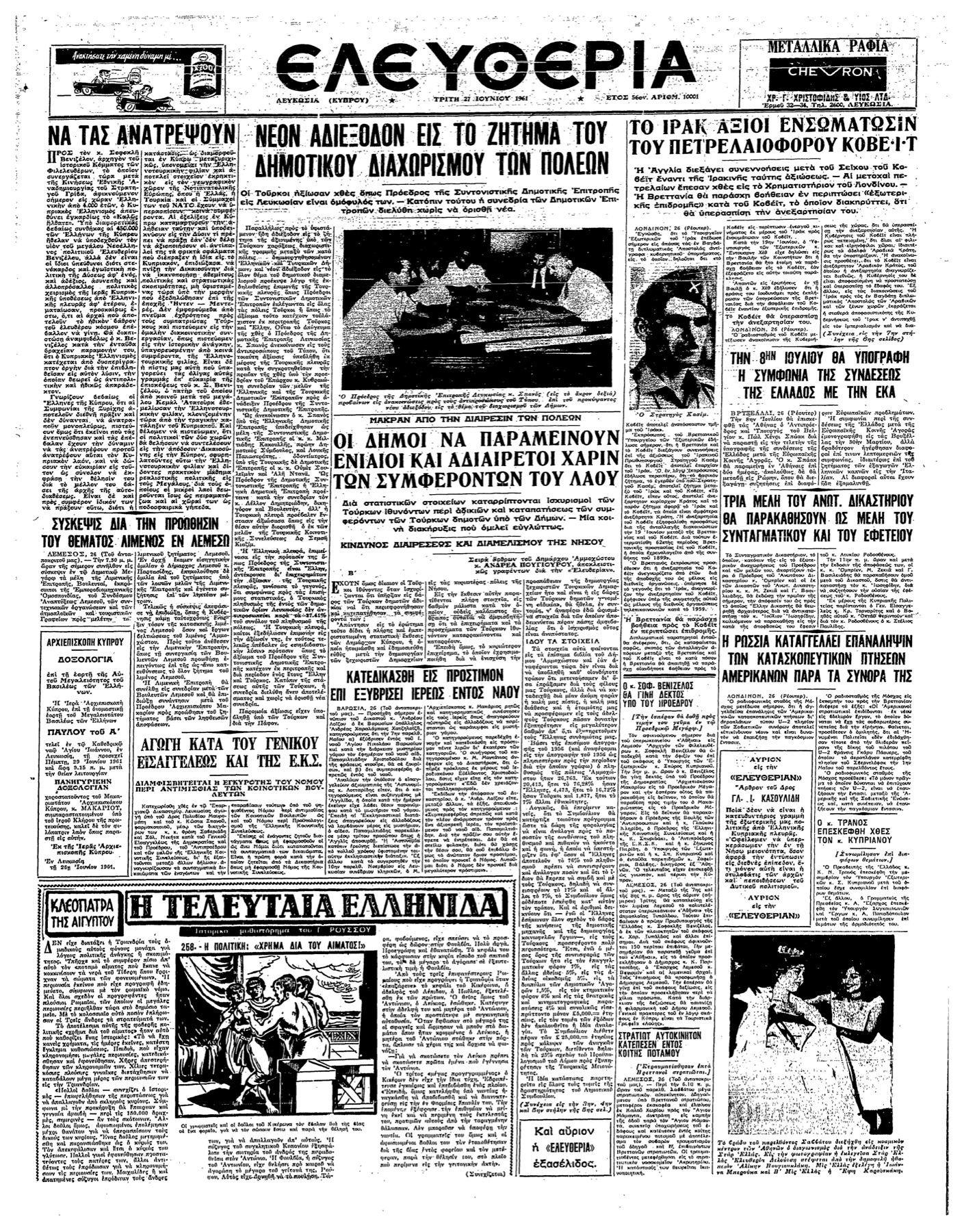
By means of statistical data the claims of the Turkish leaders concerning injustices and the trampling of the interests of the Turkish citizens by the Municipalities are refuted. — A joint declaration that speaks eloquently.
DANGER OF DIVISION AND PARTITION OF THE ISLAND
Are the Turkish leaders right, however, when they claim that there were injustices against the Turkish citizens and that their interests were despised and trampled upon?
An answer to this question is given by the full and well-documented statistical report of the Mayors of Cyprus, which was prepared and published immediately after the creation of the separate Municipalities in the principal towns of the Island.
In this report complete data are set out, to such a degree indeed that no person of good faith can dispute that the arguments and pretexts of the Turkish leaders are demolished and collapse.
Since, however, the principal argument which was used to reinforce the effort for the creation of separate Turkish Municipalities was and is the “injustice” committed against the Turkish citizens, I should like, briefly, to mention here certain data by which it is proved beyond any doubt that this claim is unfounded.
HERE ARE THE DATA
These data appear in the official books of the Municipality of Famagusta and if they are mentioned now it is not in order to suggest in any way that we repented of what we did for our Turkish friends, but in order to demonstrate once more our good faith, our good disposition and our readiness to offer to our Turkish brothers every possible service to a greater degree than we serve our Greek fellow-citizens.
According to the official census of 1956 (and I refer to the census of 1956 as being the nearest to the period about which I am writing) the population of the town of Famagusta was 26,763. Of these, 20,413, that is 76.28%, were Greeks, 4,473, that is 16.72%, were Turks, and 1,877, that is 7%, other nationalities.
Logically, one would have expected that the Council would draw up such a programme that the burdens of taxation would be proportional to the percentage of the composition of the population, and possibly the voice might even have been heard which would maintain that since the Greeks constitute 76% of the population they should also contribute a corresponding amount, and that the same should apply to the Turks, that is they should contribute 17%, and the others 7%. The Council, however, never thought in this way. And the figures show that — while the Greeks bore almost the entire burden of the running of the municipal machine and of the creation of works of public utility — much more was offered to the Turks. Thus, while the average contribution of the Turks was 7% in the professional tax, 5% in the other licences, 5% in the building licences, 1.5% in the tolls of the Municipal Markets, 6% in the property tax and 4% in the theatrical and cinematographic performances, and in total only £5,000 was collected annually, in the sector of expenditure the same proportion was not followed. The Council allocated more than £25,000 annually to cover the needs of the Turks, that is almost 25% of the Budget of the Municipality was allocated for the service of the Turkish Minority.
The same situation was observed in all the sectors of the activity of the Municipal Council.
(Continuation in the 3rd, 4th and 5th columns of page 5.)
(Continuation from page 1.)
For example, in the sector of the asphalting of roads, in the Old Town — where Turks live — the total length of the roads is 6.15 miles. The asphalted roads covered 4.20 miles and only 2.45 miles of roads were without asphalt. During the first four years of the term of the present Municipal Council, and specifically from June 1953 to June 1957, roads of a total length of 2 miles were asphalted in the Old Town, that is 36.8% of the total length of the roads in Old Famagusta.
In Varosha, where the total length of the roads is 144.35 miles, the asphalted roads covered, during the period of which we are speaking, 28.80 miles, and the roads without asphalt covered an extent of 115.55 miles.
Within the same period of 4 years roads of an extent of ten miles were asphalted, that is 6.9% of the total length of roads, in contrast to the 36.8% in Old Famagusta.
But also in the sector of loans we did not wish to wrong our Turkish friends.
The Municipality, up to the period about which we are writing, contracted loans amounting to £362,771. Of this amount the Council allocated £66,841, that is 18.43%, for purposes of Old Famagusta. Workers’ houses were built (73 in number), plots were purchased for these houses, a municipal market was erected, etc., without this amount including the expenses which were incurred for electrification, water supply and the related extensions.
But we also took care for the payment of the school fees of the poor Turkish pupils of Secondary Education, just as we took care for their feeding as well as for all the expenses of the national holidays of the Turkish minority.
For all this activity of ours, for this good disposition of ours and for our concrete offering to the Turkish minority, we repeatedly received the congratulations not only of the ordinary Turkish citizens but also of the Turkish Municipal Councillors themselves, who — admittedly — before the English put their finger in, cooperated with us with sincerity, honesty and without ulterior motives.
It is therefore clear as daylight that everything that was done in the direction of the creation of separate Turkish Municipalities was done in order to serve illegitimate political aims and pursuits.
DANGER OF PARTITION OF THE ISLAND
The creation of separate Turkish Municipalities took place in a period of intensification of political antagonisms, a deliberate intensification, in such a way that on the one hand the existence of a separate Turkish situation might be “justified,” and on the other hand the solution of the Cyprus question might be complicated.
Now that the inflamed spirits have been calmed and, for better or worse, we have reached a new state of affairs, which the Greeks did not expect and the Turks did not hope for, it is time for us to think with greater sobriety.
It is time for us to appreciate that the creation of separate Turkish Municipalities in the towns not only runs counter to internationally recognised principles and values but also sows the seed of a division which, in the long-term perspective, may constitute a permanent state of affairs, on the basis of which it is not excluded that the enemies of the interests of the Cypriot people may seek the definitive division and the partition of the Island.
Such a situation will not be detrimental only for the Greeks. It will be equally, or even to a greater degree, detrimental also for the Turks. And it is my belief that nothing separates the Turks and the Greeks except, of course, the artificially and in a surreptitious manner created situation of separation. In my ears there still resound the clear and categorical declarations which the Turkish representatives made at a joint meeting of Greeks and Turks, which was called and took place at the Municipal Offices of Famagusta on 5/6/1956. In an atmosphere of cordiality, in an atmosphere of sincere disposition for the service of the common interests and an atmosphere of optimism for the future, all Greeks and Turks proclaimed five years ago: “.... We all arrived at the unanimous conclusion that the problem of Cyprus is a political problem. However, the meeting was not called with the purpose of studying the political problem, inasmuch as it believes that whatever the present or future developments of it may be, the Greeks and the Turks will continue to live in the same town, in the same area and in the same village, not because this is a matter of preference or liking but because we are all members of one unified and indivisible whole, which has common economic and social interests.”
“At the meeting it was stressed by all the speakers — the declaration continues — Greeks and Turks, that we are all brothers and must live as brothers — regardless of whether we have different political conceptions and views. Let us reflect that up to today we have lived together in love and harmony, that we have dwelt together, that we have eaten at the same table, that we have frequented the same centre, that we have worked and work in the same place and under the same conditions as friends, collaborators and companions.”
And this historic declaration emphasises in conclusion: “... Forward, then, with the slogan: The Greeks and the Turks of Cyprus, under any conditions and circumstances, to live together as brothers and loved ones.”
I considered it useful to quote these words, because they are words which express the real and genuine feelings of the entire people and because I believe that these feelings continue to exist even today.
If, therefore, this is how things stand — and undoubtedly this is how they stand — then it is not at all difficult to understand what purpose is sought to be served by the creation of the separate Municipalities.
Part C
“Eleftheria”, 28 June 1961 — Pages 5 and 6
The division of the Municipalities will be followed by the pursuit of the territorial partition of the Island. — Today, not tomorrow, is the most suitable time for the unification of the Municipalities. — What ought to be done if the Turkish side persists to the end in the separation.
Article 20 of the Zurich–London Agreement and Article 173 of the Constitution provide for the creation of such Municipalities in the five principal towns of the Island. The same articles provide that the President and the Vice-President will examine within four years the question of whether this separation of the Municipalities will continue to exist or whether the Municipalities will be unified into one single Municipality for each town.
I believe that it is the duty of each one of us, and indeed a sacred duty, for all of us to assess the situation correctly from now on in order to avoid the trap which has been so skilfully placed in our path. And I mean that we should all assess the situation correctly, both Greeks and Turks. For it is certain from now that the enemies of the people and of its interests, once the Municipalities are created, will try to ensure that the creation of the separate Turkish Municipalities constitutes not a temporary situation — as the agreement and the Constitution provide — but a stable and permanent situation from which no power will be able to extricate us.
The existence of separate Municipalities will be accompanied by the effort to create a new state of affairs, the characteristic feature of which will be the creation of a separate “Turkish national sentiment” and the attribution of a “national” character to every municipal manifestation and activity, with the exclusive aim of serving purposes known to us.
The evil will be even greater if within the jurisdiction of the Turkish Municipalities Greeks and Greek property are also included. Since the aim pursued is not the service of the interests of the citizens in the properly understood sense of the term but the service of more remote political pursuits, it is certain that in the course of time the Greek population will be ostracised, and the possibility of the creation of a purely Greek and a purely Turkish area must not be excluded — a fact which will constitute firstly a substantial division on the basis of racial discrimination, and secondly the experiment for the pursued territorial partition of the Island.
Consequently, on the Greek side it is imperative that the question be clearly posed on this basis and that it be requested that we should not proceed to the creation of separate Turkish Municipalities, since the consequences will be generally detrimental for all Cypriots.
The division will have as an inevitable consequence the non-existence of contact and the creation of a hotbed of friction, misunderstandings and continuous conflict, and it is imposed in the interest of all of us that this be avoided.
The most suitable time for the unification of the Municipalities is today and not tomorrow. Tomorrow may be too late, far too late for all, inasmuch as the consequences will affect the entire people, indiscriminately and irrespective of nationality and religion.
For this reason our proposal, which ought to take the place of a last appeal to the Turkish side, must be clear and concrete: “Away from the division of the towns. Away, because the seed of partition is being sown with all its evil consequences.”
ZONES OR BOUNDARIES MUST NOT BE DEFINED
If our proposal — our appeal — does not find the appropriate response and does not meet with the due reception, the second step which we must take is to struggle for the prevention of the territorial partition of the towns. If the Vice-President and the Turkish political factors desire the existence of separate Turkish Municipalities and insist on the application of the right which the agreement and the Constitution offer them, then our own effort must aim at ensuring that the territorial partition is not realised through the definition of boundaries or zones.
The Turkish Municipalities can function — independently, of course, of the consequences — without boundaries or zones being defined. They can function in order to collect the taxes from the Turkish citizens and to collect the rubbish from their houses, wherever these may be located, without the signs or the barbed wire being placed which would define the “Turkish borders.”
Moreover, the agreement and the Constitution provide for the creation of a Coordinating Body, which will consist of two Greeks and two Turks with an “independent” President and which will look after the “matters of common interest,” and consequently the territorial partition is not going to serve anything good.
These views and my concrete suggestions I have transmitted by letters and memoranda both to the President and to the Vice-President of the Cypriot State, and on other occasions also I have been given the opportunity to repeat and analyse them.
In the Committee which was set up by the President and the Vice-President for the purpose of studying and recommending which roads will come under the Greek and which roads under the Turkish Municipality, and which — as is known — consisted of Greeks and Turks, we clearly set out our views and underlined the dangers which we shall all run. We stressed that the creation of separate Municipalities is not conceivable either from the legal point of view, or from the point of view of administrative law, nor from the fiscal or social point of view. And we developed our views at length, towards which, while we had no disagreement on the part of the Turkish representatives as regards the disastrous consequences which will follow the creation of separate Municipalities and the partition, we nevertheless encountered their insistence on the territorial partition, which they see as indissolubly linked with the creation of the separate Turkish Municipalities.
This insistence of the Turkish members, which is based on the mistaken conception that the existence of separate Turkish Municipalities is not (for them) conceivable without the existence also of separate Turkish municipal boundaries, is for us an insistence contrary both to the agreement — which, it should be noted, makes no mention of the definition of boundaries — and to the Constitution itself.
Article 20 of the Agreement and Article 173 of the Constitution provide for the establishment of separate Municipalities in the five principal towns of Cyprus by the Turkish citizens for the Turkish citizens. Nowhere is it stated that separate Municipalities will be created by the Turks and for Greeks, obviously because the authors of the agreement and the drafters of the article would have made themselves ridiculous if they had noted that separate Municipalities would be created, Turkish ones but for Greek citizens. It is therefore an indisputable fact that the agreement and
(Continuation in the 7th column of page 6.)
(Continuation from page 5.)
the Constitution provide for Turkish Municipalities but for the Turks only, and the Turkish side would perhaps have been more within its “rights” if it had insisted that zones or boundaries be defined in the areas which are inhabited exclusively and solely by Turks and the property within them is purely Turkish property, compact, unified and continuous.
The Turkish side, however, did not confine itself to the “rights” which the agreement and the Constitution offered it. The Turkish side went far beyond the limits of its rights, with a clear effort and pursuit to place the boundaries of its Municipalities outside its own limits and indeed to place them in the centre of the municipal boundaries of the towns.
Especially as regards Famagusta, the Turkish side demanded that the Turkish municipal boundaries be defined not in a section of the Old Town — as a calm and logical person would have expected — but in the heart of the town as far as the terminus of the municipal boundaries at Engomi, with the inclusion within them of 70 Greek streets and Greek property of incalculable extent and value.
TOMORROW: In Nicosia the Turks are asking for half the city, the same also for Limassol, while acceptance of their claims for Paphos and Larnaca would mean tragedy.
Part D (last)
“Eleftheria”, 29 June 1961 — Page 2
No concession whatsoever is justified towards the views of the Turks who pursue the partition of the towns. — Non-unification of the Municipalities would mean mourning over ruins.
But this situation is not observed and is not confined only to Famagusta. In Nicosia the Turks are asking for half the city, as is the case also in Limassol, in Larnaca and in Paphos, and it would constitute at the very least a tragedy if any intention of accepting the Turkish demands were manifested. The claimed areas are inhabited by Greeks, the properties within them of enormous extent and value are Greek, and no argument could justify any concession on our part, since such a demand or concession conflicts with the letter and the spirit of the agreement and of the Constitution.
Especially for Nicosia the dividing line would be in the centre of the capital, and it would be very painful if both we and the foreigners who will visit the capital were to find ourselves faced with a situation which would recall the period of the state of emergency, during which Nicosia was divided by barbed wire into two, and which would bring to the memory of all the case of Jerusalem, which is divided into a Jewish and an Arab sector, and would present an appearance for which future generations — if of course such a thing is permitted — will bring the great accusation of lack of courage in the defence of the interests of the people.
Is it not therefore clear that the Turks are violating the agreement and the Constitution? If they persist to the end in this incomprehensible demand, and it is accepted, this will mean that the separate Turkish Municipalities are not being created by the Turks for the Turks, but by the Turks for Turks and Greeks, and consequently they ought not to be called Turkish but Turco-Greek Municipalities.
We consider that the insistence of the Turkish side must be regarded as contrary both to the letter and to the spirit of the Agreement, and as such it must be rejected. This opinion of ours has been supported by distinguished English jurists, who clearly indicated that the definition of boundaries is contrary to the agreement, as well as by other foreign and compatriot lawyers.
It is for this precise reason that we in our turn indicated that, since the Turkish side insists on the creation of separate Municipalities, it is obliged to respect the agreement and not to seek the abuse of a right which was offered to it. Otherwise a constitutional issue is created, the solution of which must be sought for the sake of the general interests of Greeks and Turks.
We are not imbued with anti-Turkish sentiments. We respect and esteem the Turks as our brothers. We respect and esteem them as people with whom we have lived together, worked together, eaten together and have generally been collaborators and friends.
Our effort is to serve the Turks as we serve the Greeks also, because we see the interests of all as common and identical. For us there do not exist Greeks and Turks, but only citizens, and our thoughts and our actions are not influenced by political expediencies when it is a matter of serving the citizens and the interests of the city. If we have done what we have done and write what we write, we do so simply and solely because in the effort being made for partition we discern terribly serious dangers.
And concerning these dangers I have written at the beginning of the present series of articles. When the crafty Foot was about to leave the island and visited various towns in order to “bid farewell to the political factors of the island,” he considered — as he said — it his duty to make a statement (a friendly statement) to the Cypriots. This statement of his, which was made to me during his visit to Famagusta, wished to be regarded as personal and as not representing... the official English view. At the beginning this statement expressed his “great” sorrow because the Cypriot and the British people had clashed, but also his “great” joy because our in every respect worthy people had secured its freedom, and it concluded as follows: “With the withdrawal of the English from Cyprus, a long-standing colonial administration, which was in many respects oppressive, comes to an end, and broad horizons of development open before your people. The retention on our part of sovereign rights over a section of Cypriot territory and the existence of British bases secure for you three things. Firstly they guarantee your defence against external attack. Secondly they offer you money and work. And thirdly the British troops will solve... your differences with the Turks and will play the role of arbitrator.”
The third guarantee which is “offered” to us is indicative of the disposition of the English neo-colonialists and of their policy. When they cannot govern by fire and iron, they resort to diplomacy. And when this method too does not serve them, for the reason that it comes up against the intelligence and the awakening of the peoples, then they resort to intrigue. This method they themselves call “arbitration,” as if it were a matter of... a boxing match.
For us, however, this statement has great significance and seriousness. In order for English neo-colonialism to be able to “arbitrate,” it is necessary that frictions and conflicts exist. And it is precisely here that the creation of the boundaries is required, which will help in the existence of the frictions and the conflicts. I fear that before the English “withdraw” from Cyprus they took care that these conditions should be created and stabilised. While they still held in their hands the government of the island and applied law and order, they indicated to the Turks that they should break the law, permitting them to create the separate Turkish Municipalities, so that the necessary and indispensable situation should exist when the whole Cyprus question would be put forward for discussion for the finding of a solution.
And when they saw that the experiment according to their indication “succeeded,” they proceeded to the enactment of a decree, with the force of law, by which the existence of Turkish Municipalities was recognised as a legal situation, in which full rights of collection of taxes, rents, tolls etc. were granted, but obligations were not imposed such as the payment of street lighting, the payment of interest and capital on the loans and the like, and which obligations were left to the Greek Municipalities.
This alone is sufficient to prove that the creation of separate Turkish Municipalities constitutes an invention of the English, which was applied according to a plan with a long-term perspective.
The question, however, is whether the Cypriot people, as a whole, will accept and tolerate the creation of the hotbed of frictions, which will make the “arbitration” of the English necessary.
The English imperialist neo-colonialists achieved their purpose by fostering the “Turkish factor.” It now rests with us, with us Greeks and Turks as one unified and indivisible unit, to prevent the definitive application of racial discrimination, which has been condemned even by the United Nations Organisation itself as a crime against humanity.
It rests with us to destroy the seed which was sown by men alien to Cypriot interests with the aim of creating in Cyprus a permanent situation of mutual destruction.
It would be a matter for prayer if the common people on the Turkish side found the strength to meet in meetings similar to that of 5.6.1956 in order to proclaim once more “that we all — Greeks and Turks — are brothers and that we must live as brothers regardless of whether we have different political conceptions and views.”
It would be a matter for prayer if around the same table we spoke with a common language in order to ascertain that the basis from which we start leads us onto very dangerous paths and that for all there exists one common road, which leads to common interests and common pursuits.
The unification of the Municipalities from now would constitute the most brilliant manifestation of the sincere disposition of all towards the conquest of the common bright future and the first step towards the recovery of the lost mutual trust, without which nothing can be achieved, and in this direction I consider that we are obliged to devote all our forces, being certain from now that we are performing an elementary duty towards our people.
Otherwise it is equally certain that we shall mourn over ruins, the creation of which we can foresee from now.